How to Read Crochet Charts: Symbols and Abbreviations
Crochet charts can look like a secret language at first. Once you recognize the symbols and know where to begin, they become a useful picture of your stitches.
This guide explains how to read crochet charts in rows and rounds, recognize repeats, and avoid common mistakes. All stitch names below use US crochet terminology.
The essentials at a glance
- A symbol usually represents a stitch or a group of stitches.
- Worked-back-and-forth charts usually alternate reading direction after each turn.
- Motifs worked in the round often begin in the center.
- Always check the pattern legend, start marker, and written notes.
What is a crochet chart?
A crochet chart is a visual version of stitch instructions. It shows which stitches to make and how they relate to the stitches around them. Charts are especially useful for granny squares, lace, borders, and round motifs.
A complete pattern also includes information a chart may leave out, such as yarn, hook size, gauge, finished measurements, and finishing steps. Read both the chart and the accompanying instructions.
Start with the symbol legend
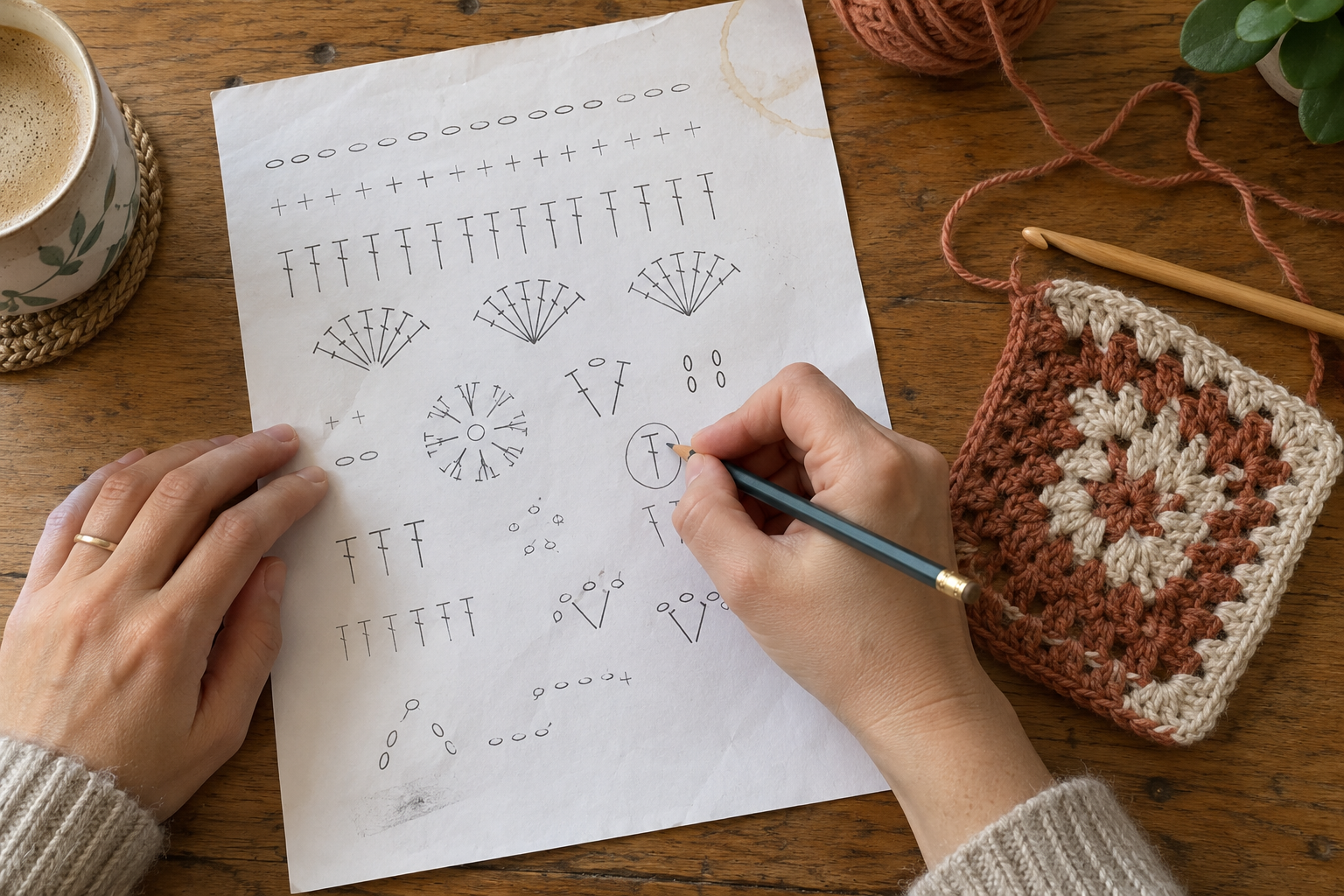
The pattern legend is your first reference. A designer may use a special symbol or give a familiar symbol a specific meaning.
For a reference chart, see the Craft Yarn Council crochet symbols.
| Typical symbol | US stitch | Abbreviation |
|---|---|---|
| Open oval | Chain | ch |
| Solid dot | Slip stitch | sl st |
| Plus sign or X | Single crochet | sc |
| T shape | Half double crochet | hdc |
| T with one diagonal stroke | Double crochet | dc |
| T with two diagonal strokes | Treble crochet | tr |
Symbol drawings can vary. Your pattern’s key takes priority.
Common US crochet abbreviations
Written notes often sit beside a chart. Along with the stitch abbreviations above, look for st (stitch), sp (space), rnd (round), rep (repeat), sk (skip), and yo (yarn over). RS and WS refer to the right and wrong sides of your work. Check the pattern’s definitions for any unfamiliar abbreviation.
Find the start before you crochet
Look for a number, arrow, or other starting marker. Identify the foundation chain or center ring, then follow the marked order. Do not assume every chart starts in the same place.
Reading rows
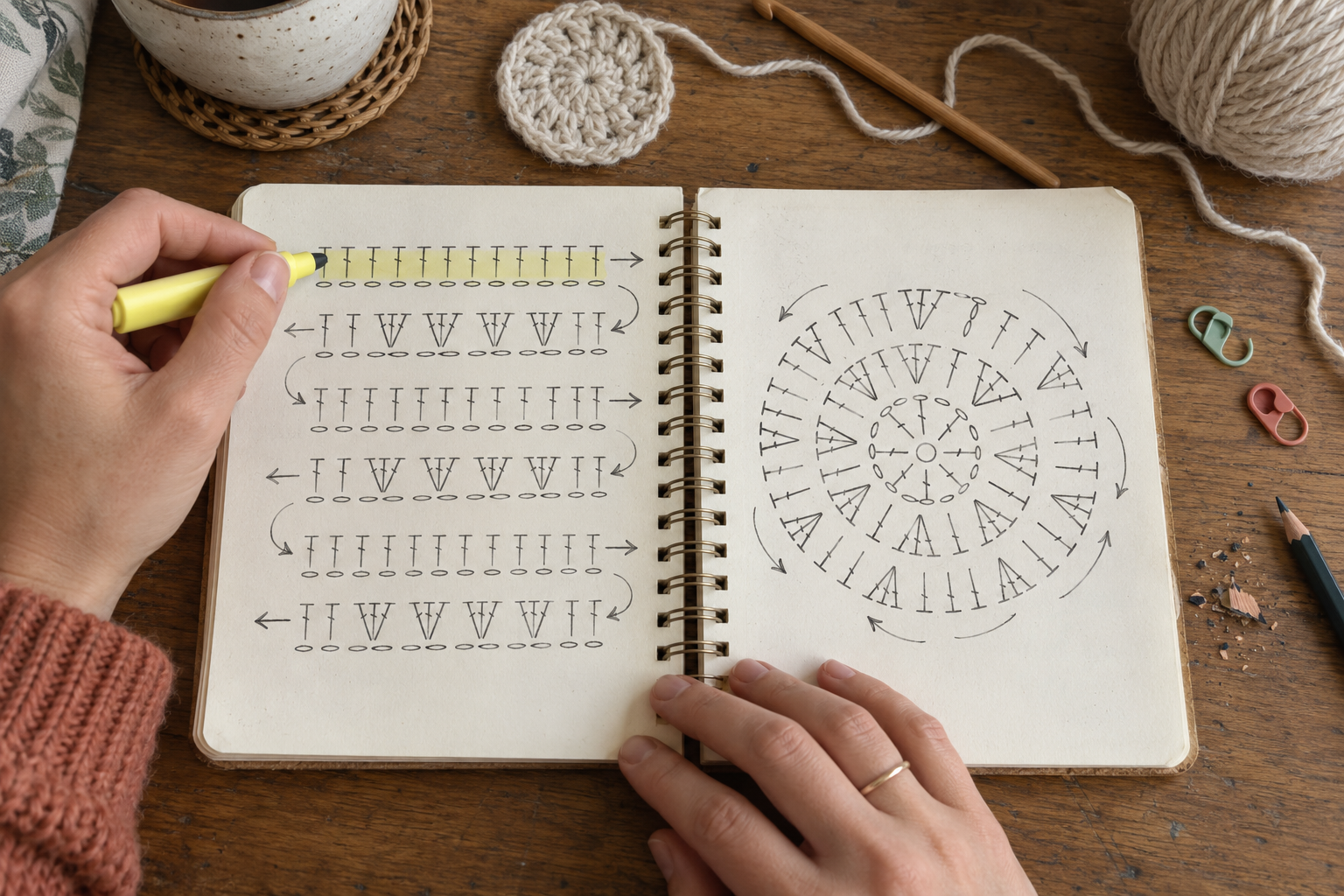
For a typical right-handed chart worked back and forth, begin at the lower edge and read the first working row from right to left. After turning, read the next row from left to right. Row numbers often appear at the side where that row begins.
- Find the foundation chain and the marker for row 1.
- Work the symbols in the indicated order.
- Follow the notes for the turning chain.
- Turn the work when instructed.
- Follow the next row in the opposite direction.
Some charts use a different construction, so arrows and written directions always come first.
Reading rounds
Many round motifs start with a magic ring or a chain ring at the center. Follow the numbered rounds outward. Right-handed diagrams often progress counterclockwise; use the direction shown in your pattern.
Check whether rounds are joined with a slip stitch, worked as a continuous spiral, or turned between rounds. These methods need different starting and finishing steps.
Recognizing repeats
A chart may mark a repeat with brackets, a shaded area, an outline, or a section of a round motif. Written instructions tell you how many times to repeat it. Parentheses can also mean several stitches worked into one stitch or space, so check the context.
Mark the current repeat with a stitch marker or place a ruler beneath the row you are following. Count your stitches after each section.
A simple example
Imagine a chart with a foundation chain, a turning chain, and a row of US double crochet stitches. This is a reading example, not a complete pattern:
- Make the number of foundation chains specified in the pattern.
- Check how many turning chains are required and whether they count as a stitch.
- Work each double crochet into the chain or space indicated by the chart.
- Count the row’s stitches before turning.
- Read the next row in the direction shown.
A chain-3 often substitutes for the first double crochet, but this is not universal. Follow the pattern notes rather than assuming it counts.
Increases, decreases, and clusters
Several symbols beginning at the same base usually mean several stitches go into the same stitch or space. Symbols that meet at the top may indicate stitches worked together.
Check the legend to distinguish a decrease from a cluster. A cluster can be worked into one location, while a decrease often combines separate stitches. Do not rely on the symbol’s appearance alone.
US and UK stitch names are different
This website uses US terms. A UK double crochet is a US single crochet, so mixing systems changes the result.
| US | UK |
|---|---|
| Single crochet (sc) | Double crochet (dc) |
| Half double crochet (hdc) | Half treble (htr) |
| Double crochet (dc) | Treble (tr) |
| Treble crochet (tr) | Double treble (dtr) |
See the Craft Yarn Council abbreviation reference for further terminology.
Common mistakes to avoid
- Skipping the legend: identify every symbol before starting.
- Losing your reading direction: check each row number or arrow.
- Miscounting turning chains: confirm whether they count as stitches.
- Missing part of a repeat: mark its beginning and end.
- Mixing US and UK terms: check the terminology before choosing a stitch.
- Waiting too long to count: compare your total with the pattern after every row or round.
Practice with a small project
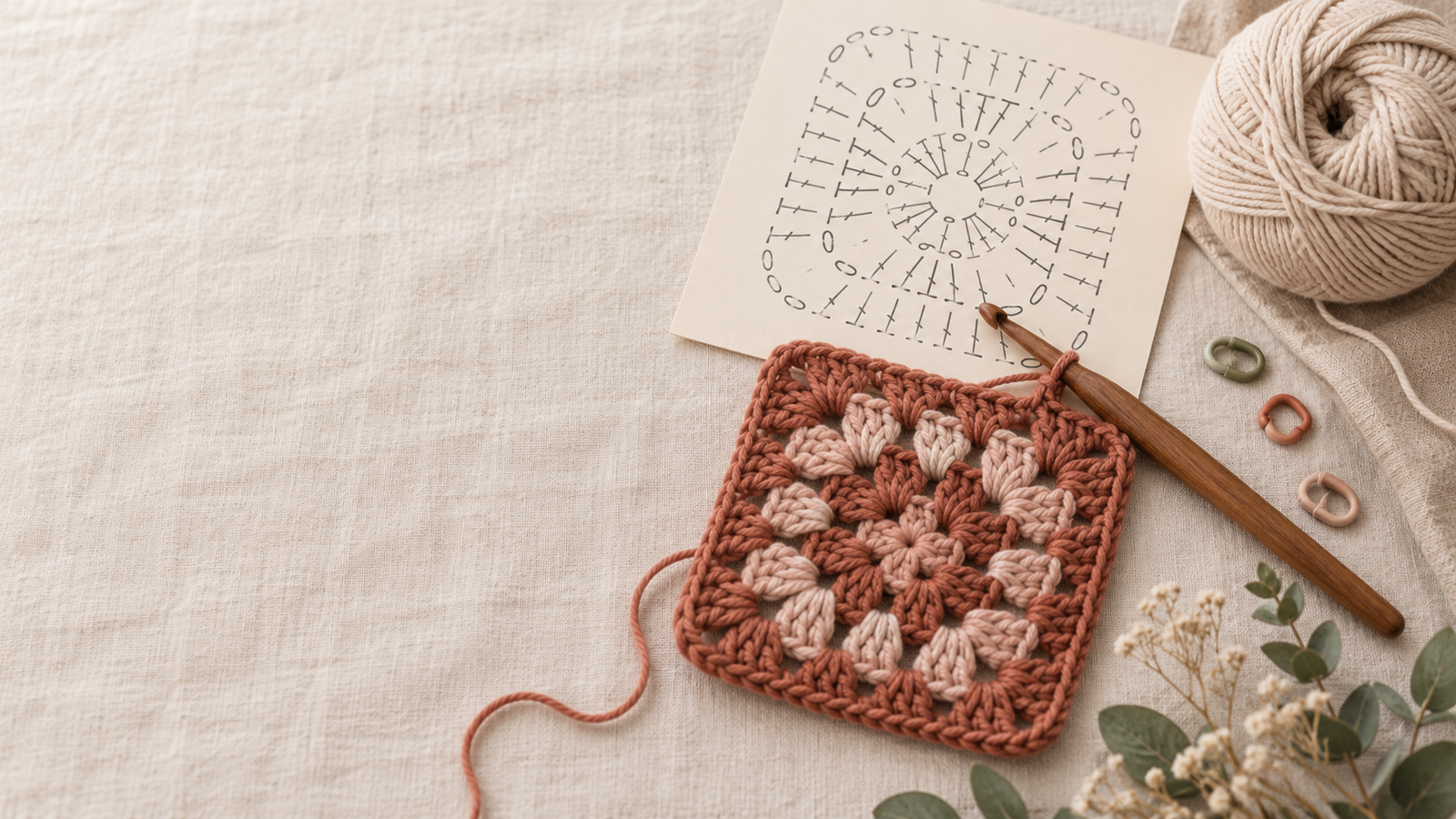
Choose a swatch, simple border, or granny square using only a few stitch types. Keep the legend beside you, track the current row with a ruler, and compare your work with the pattern’s finished photo. A small practice piece makes corrections easier.
Checklist before your first stitch
- Do my yarn and hook match the pattern?
- Have I checked the gauge if size matters?
- Do I understand the legend?
- Where does the chart start?
- Am I working in rows, joined rounds, or a spiral?
- Does the turning chain count as a stitch?
- Where does each repeat begin and end?
- How many stitches should I have?
Frequently asked questions
Are crochet symbols the same everywhere?
Many basic symbols are widely used, but designers can vary them. Always read the supplied key.
Where does a round chart begin?
Often at a center ring. Check the starting marker and written instructions, then follow the rounds outward.
Do turning chains count as a stitch?
It depends on the pattern. Look for a note that explains whether to count them and where to work the first and last stitches.
Can left-handed crocheters use a chart?
Yes. You may need to reverse the reading direction for back-and-forth rows. Look for left-handed guidance from the designer, especially for directional motifs, lettering, or asymmetrical designs.
Build confidence one row at a time
Begin with the legend, find the start, and follow the direction markers. With repeats marked and stitches counted regularly, a complicated-looking chart becomes manageable.
Save this guide for your next project and explore more learning resources on our Tutorials page.